
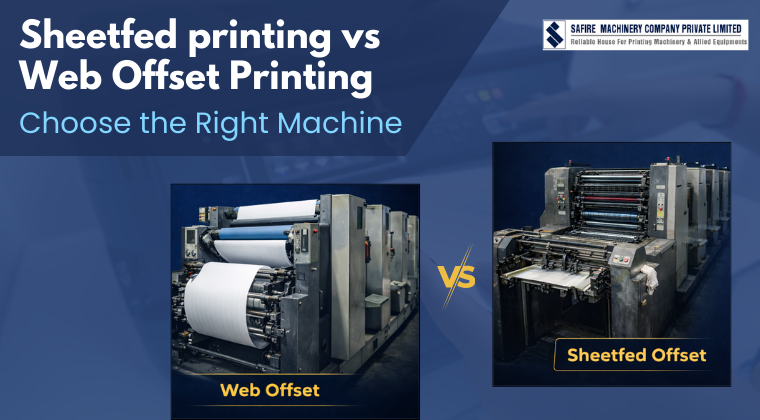
Choosing the right printing technology is a critical business decision. The debate around Sheetfed printing vs Web Offset Printing often creates confusion among buyers planning new investments or upgrading production lines.
Wrong selection may lead to low utilization, higher operational expenses, and poor return on investment. This guide helps printing business owners to make informed decisions about printing equipment.
What is Sheetfed Printing?
Sheetfed printing is a traditional offset printing technology where individual sheets are fed into the press for printing. This method is widely used in commercial and packaging industries. A sheetfed printing machine provides high flexibility in handling different paper types and thicknesses. Businesses dealing with premium printing jobs prefer this technology because of better finishing control.
Unlike continuous roll printing, sheetfed presses work on discrete sheet processing, allowing customization and short-run production.
How Sheetfed Printing Works
In sheetfed printing, individual paper sheets are fed into the machine’s feeder system. Each sheet travels through multiple printing cylinders where ink is precisely transferred onto the surface using offset printing plates for accurate reproduction.
This technique is widely adopted in commercial printing environments, especially within offset printing workflows, delivering consistent quality and reliable performance for business printing requirements.
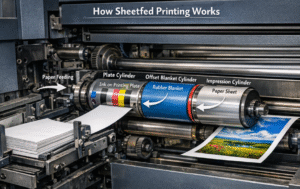
Sheetfed Printing Machine Working Process
Pros of Sheetfed Printing
- Supports varied paper quality and thickness
- Ideal printing machine for small business and medium-scale operations
Cons of Sheetfed Printing
- Production speed is moderate
Best Applications of Sheetfed Printing
- Corporate brochure printing
- Short-run book publishing
Many growing commercial printers choose a sheetfed printing machine because it balances flexibility and production control.
What is Web Offset Printing?
Web offset printing is built for large-scale, continuous production requirements. This web offset printing machine utilizes paper rolls rather than single sheets, enabling faster output and cost-efficient mass printing. It is commonly preferred by large publishing companies and industrial printing units handling high circulation orders.
Working Mechanism of Web Offset Printing
Paper is supplied from large continuous rolls into the press for printing. Once printing is completed, the material is automatically cut, folded, or further processed according to the final product specifications and production requirements.
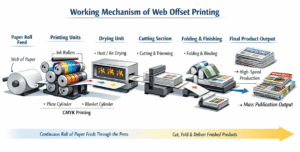
Web Offset Printing Working Process
This printing approach is highly effective for mass publication needs, supporting large circulation printing, faster production cycles, and cost-efficient output for high-volume publishing projects.
Pros of Web Offset Printing
- Extremely high production speed
- Low cost per copy in bulk printing
Cons of Web Offset Printing
- Higher initial investment
- Requires industrial infrastructure
Ideal Applications
- Newspaper printing
- Magazine publishing
If your business handles large circulation printing, a web offset printing machine is a powerful production asset.
From small print shops to large production units, Safire Machineries offers used printing machines suited for every printing requirement
Sheetfed Printing vs Web Offset Printing Comparison
1) Speed and Production Capacity
In the comparison of Sheetfed printing vs Web Offset Printing, speed plays a crucial role Web offset printing machines are built for high-speed mass production, achieving around 80,000 impressions per hour in advanced setups.
Sheetfed printing machines, on the other hand, operate at lower speeds but offer better precision, quality control, and flexible production management.
2) Cost and Investment Risk
Sheetfed printing machine is a safer option for small and medium printing businesses, offering flexible production and lower infrastructure cost. Operating expenses are also moderate, making it suitable for controlled commercial printing operations.
Web offset printing machines involve higher capital investment due to large-scale setup, roll handling systems, and industrial production infrastructure. While the upfront cost is high, it becomes economically efficient by reducing cost per copy in long-term operations.
3) Paper Type Compatibility
Sheetfed printing machines offer high paper type compatibility, supporting coated sheets, textured boards, and specialty printing materials. This flexibility makes them suitable for premium commercial and packaging applications requiring superior finishing and quality control.
Web offset printing machines are mainly optimized for lightweight continuous paper rolls. They are ideal for large-volume publications such as newspapers and magazines, where production speed and cost efficiency are more important than paper variety.
4) Maintenance and Operating Cost
Sheetfed printing machines generally require moderate maintenance due to simpler mechanisms. Operating costs remain manageable, making them suitable for commercial and medium production printing businesses.
Web offset printing machines involve higher maintenance expenses due to complex roll systems and high-speed operation. Regular technical servicing is essential to maintain industrial-scale production efficiency.
Here is a short table for quick summary:
| Factor | Sheetfed Printing | Web Offset Printing |
| Speed | Moderate | Very High |
| Cost | Medium investment | Better for bulk cost efficiency |
| Paper Type | Flexible | Roll-based paper |
| Maintenance | Easy | Complex |
| Usage | Commercial jobs | Mass publication |
How to Choose the Right Printing Machine?
Before purchasing a printing machine, carefully evaluate production volume, available workspace, maintenance support, investment capacity, and long-term business expansion plans.
A proper technical and financial assessment improves printing machine comparison decisions, reduces operational risks, and ensures sustainable performance, efficiency, and profitability.
Why Choose Used Printing Machines in India?
Investing in refurbished printing machines is a smart and economical choice for printing businesses. Safire Guna Machineries is a used printing equipment dealer, helping reduce upfront investment while ensuring reliable production performance. This approach supports access to advanced printing technology with better operational efficiency and controlled costs.
Advantages include:
✔️ Lower capital investment
✔️ Access to premium technology
✔️ Verified machine performance
✔️ Technical support availability
Safire Guna Machineries specializes in supplying quality-tested printing machinery solutions for Indian printing businesses, ensuring reliable performance and investment value.
Final Words
The choice between Sheetfed printing vs Web Offset Printing depends on your business model, investment capacity, and production demand. If you are planning to invest in a reliable used offset printing machine, professional guidance is essential.
Connect with Safire Guna Machineries for trusted used printing machine India options and practical offset printing solutions.
Enquire today and build a profitable printing production setup.
FAQs
1) Which is better: Sheetfed printing vs Web Offset Printing?
It depends on the business scale. Sheetfed is flexible; web offset is high-speed bulk production.
2) Is web offset suitable for small businesses?
Generally not, unless there are consistent high-volume orders.
3) What industries use sheetfed machines?
Packaging, commercial printing, and short-run publishing.
4) Is buying used printing machines safe in India?
Yes, if purchased from trusted dealers with technical inspection.
5) How to improve printing machine ROI?
Focus on volume optimization, proper maintenance, and client segmentation.
